Guide
Point of sale software in Algeria: what the 2026 Finance Act changes from 1 January 2027
From 1 January 2027, a shopkeeper liable for VAT who records sales made without an invoice using software or a till system will have to present, for any tax audit, a commitment from the software’s publisher or a certificate from an authorised accreditation body. This document states that the software meets four conditions: inalterability, security, retention and archiving of data. This page quotes the texts and explains what Stockivia does on each of these points.
· Published by Stockivia, the maker of the software described on this page.
In short
- Text: Law no. 25-17 of 14 December 2025, the Finance Act for 2026, Official Journal no. 88 of 31 December 2025.
- Articles: 58 (article 51 bis of the turnover tax code), 74 and 81 (articles 20 ter and 51 sexies of the tax procedures code), 109 (effective date).
- Effective date: 1 January 2027.
- Document required: a commitment from the software’s publisher, or a certificate from an authorised accreditation body.
- Still awaited: the order of the Minister of Finance setting the templates of the commitment and of the certificate.
- Stockivia: an unalterable sales journal and recorded register closings. Stockivia does not present itself as certified software.
What the texts say
The Finance Act for 2026 creates three articles that concern point of sale software. We summarise them here: only the official text is authoritative.
- Article 58: it creates article 51 bis of the turnover tax code. Any person liable for VAT who makes sales or provides services that do not give rise to an invoice, and records them with software or a till system, must present a commitment from the publisher, or a certificate from an authorised accreditation body, stating that the software meets the conditions of inalterability, security, retention and archiving of data, for any tax audit.
- Article 74: it creates article 20 ter of the tax procedures code, which repeats this obligation and states that its application rules, and the templates of the commitment and of the certificate, are set by order of the Minister of Finance.
- Article 81: it creates article 51 sexies of the same code. Companies or operators that publish accounting software, management software or till systems, or that work technically on functions of these products affecting, directly or indirectly, the recording of accounting entries, must give the tax administration, at its request, all the related codes, data, processing or documentation.
- Article 109: these provisions take effect from 1 January 2027.
Who is affected
Article 51 bis covers persons liable for VAT who sell without issuing an invoice and record these sales with software or a till system: this is the situation of many retail shops.
If your shop comes under another regime, for example the single flat-rate tax (IFU), ask your accountant or your tax office whether this applies to you: this page does not replace their advice.
What is not yet set
Two things are still missing before these documents can be drawn up: the order setting the application rules and the templates of the commitment and of the certificate, and the authorisation of bodies to accredit software or till systems. When this page was last updated, we had found neither in the Official Journal. The effective date is already set: 1 January 2027 (article 109).
Until the official template exists, the publisher’s commitment cannot be issued in its official form.
What Stockivia does on the four conditions
These mechanisms already exist in the Premium version. The free demo has them too, with one exception: its “Remove the examples” button erases the whole history of the demo, sales and closings included.
- Inalterability: each completed sale, each cancelled cart and each register closing is added to a journal numbered without gaps, where each entry is sealed to the one before. A completed sale cannot be changed or deleted: a mistake is corrected with a return or a credit note, which leave their trace.
- Security: the data is encrypted on the PC, each cashier has a PIN, and sensitive actions (discounts, returns, price changes) can require the manager’s approval and are recorded in a log. A change made with a database editor, outside the software, is reported by the data check.
- Retention: the data stays on your PC, with automatic backups every day and at each register closing, an optional copy to a USB key and, with Premium, an encrypted online backup.
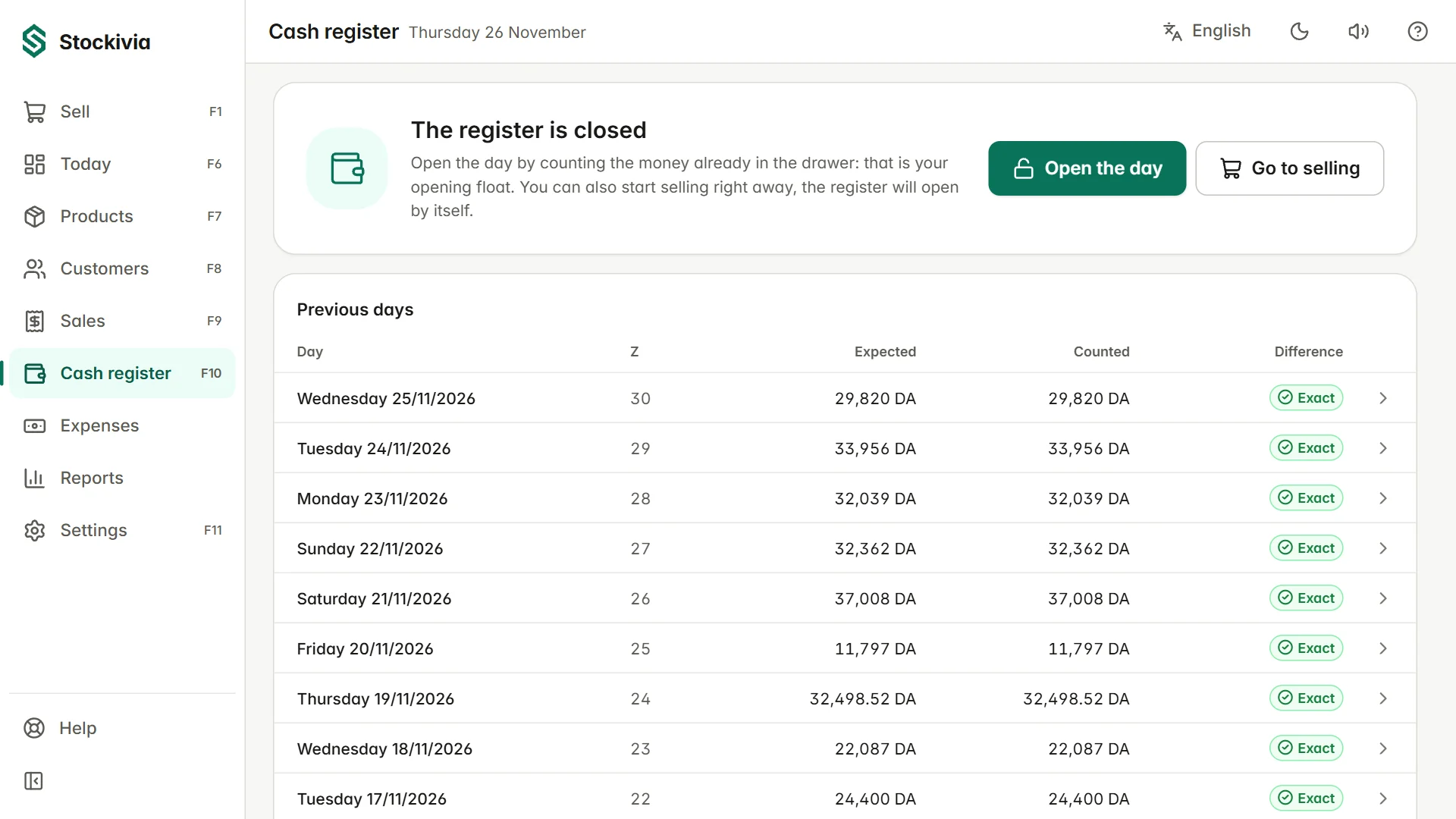
- Archiving: at each register closing, the day’s summary is recorded with its number and can no longer be changed. Previous days remain available to consult.
What Stockivia does not claim
On a legal subject, precision matters more than promises.
- Stockivia is not “certified” software: as far as we know, no body has yet been authorised to accredit software or till systems.
- The publisher’s commitment cannot yet be issued in its official form: its template must first be set by the order.
- This page is general information, not tax or legal advice.
What you can do now
Whatever software you use, five simple habits prepare you for 2027.
- Ask the publisher of your current software what it plans for 2027.
- Check that a completed sale can no longer be changed or deleted in your software.
- Close the register every day and keep the summaries.
- Keep backups away from the shop’s PC.
- Talk to your accountant about it.
Frequently asked questions
When do these rules apply?
From 1 January 2027, under article 109 of the Finance Act for 2026.
Do you have to buy a particular cash register?
The articles quoted speak of software or a till system, and of a document that vouches for it: the publisher’s commitment or a certificate. They do not impose a model of device.
Is Stockivia certified?
No, and we do not claim to be: as far as we know, no body has yet been authorised to accredit software or till systems, and the template of the publisher’s commitment has to be set by order. Stockivia already applies the technical mechanisms described on this page.
Does this apply to a shopkeeper under the IFU regime?
Article 51 bis covers persons liable for VAT. If you are under the single flat-rate tax, check your situation with your accountant or your tax office.